
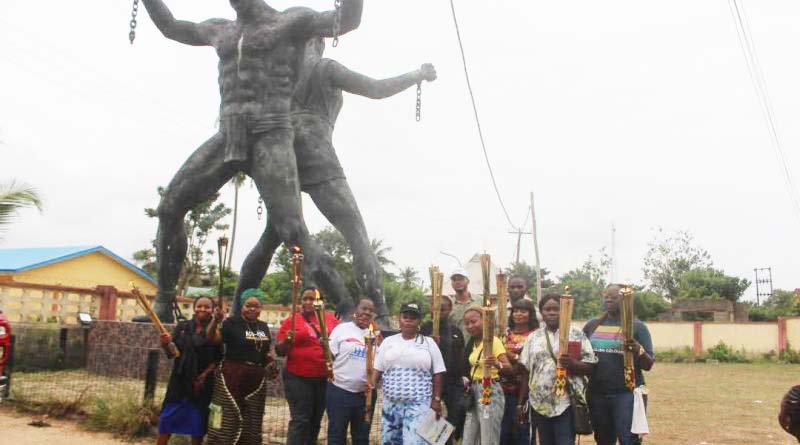
The Lagos State Ministry of Tourism, Arts and Culture, in partnership with Badagry Local Government and the Confederation of Badagry Tourism Practitioners, on Saturday commemorated the International Day for the Remembrance of the Slave Trade and Its Abolition at the Badagry Heritage Museum.
The event, observed globally every 23rd August, honours the historic Haitian Revolution of 1791 in Saint-Domingue (modern-day Haiti), which marked a turning point in the fight against slavery and the transatlantic slave trade.
Representing the Lagos State Government, Hon. Solomon Bonu, Chairman of the House Committee on Tourism, Arts and Culture, reaffirmed the State’s commitment to harnessing Badagry’s history to promote cultural tourism, intercultural dialogue, and economic growth through heritage preservation.
He emphasised that Lagos would continue to support the revival of Badagry’s tourism sector and urged stakeholders to collaborate in positioning the division as a globally recognised hub of remembrance and cultural heritage.
The Executive Chairman of Badagry Local Government, Hon. Babatunde Hunpe, described Badagry as “Nigeria’s Jerusalem,” citing its historic role as a major slave route in West Africa. He thanked President Bola Ahmed Tinubu, Governor Babajide Sanwo-Olu, and UNESCO for their sustained support in preserving the town’s heritage.
“Badagry is blessed with natural and cultural endowments that the world must see,” Hunpe said. “It is our duty to preserve them for future generations while transforming painful memories of the past into platforms of healing, learning, and pride.”
Delivering a commemorative lecture, Professor Adejumo Tunji of the University of Lagos underscored the importance of community participation in tourism development. He highlighted the Community Tourism Initiative (CTI) introduced by the United Nations and urged Nigeria to embrace community-based tourism, stressing that it would not only benefit the present but also future generations.
He further called for proper documentation of Badagry’s historic sites as a pathway to repositioning the town as a global destination for cultural tourism.
A goodwill message from UNESCO’s Director-General, Audrey Azoulay, reminded participants of the importance of remembering victims of slavery, honouring their resistance and resilience, and building a future based on dignity, equality, and justice.
The commemoration featured a fitila (torchlight) procession, cultural performances, and reflections by traditional leaders on the role of indigenous belief systems in preserving identity and resilience.
The event drew participation from traditional rulers, cultural troupes, community leaders, and the Confederation of Badagry Tourism Practitioners, who collectively pledged to work with Lagos State and UNESCO to reposition Badagry as a global hub of remembrance, heritage, and cultural tourism.